
Read Betting Odds Fast: Master the 3 Formats U.S. Bettors Need
Odds come in three formats, American (moneyline), decimal, and fractional, and each number tells you the same two things: how likely an outcome is and how much you stand to win. Every sportsbook board, no matter the sport, is built on this shared logic. Learn to convert between the three and calculate implied probability, and you can compare any line on any app in seconds.
TL;DR:
- Converting between odds formats and implied probabilities is essential for quick, accurate comparison of betting lines across multiple sportsbooks.
- American odds highlight profit relative to a $100 stake, with favorites marked by negative numbers and underdogs by positive numbers, influencing payout expectations.
- Decimal odds reflect total return per dollar staked, making mental calculations straightforward, especially for in-play betting or quick estimates.
- Fractional odds emphasize profit-to-stake ratios and are more common in UK and horse racing markets, requiring familiarity with their conversion to other formats.
- Lines shift frequently during the lead-up to events due to injuries, weather, and betting volume, so comparing odds early and often improves value and reduces vig costs.
Table of Contents
- How to Read American (Moneyline) Odds
- How to Read Decimal Odds and Calculate Your Return
- How to Read Fractional Odds and Convert Them to Payouts
- Converting Between Odds Formats and Finding Implied Probability
- How Odds Show Up on Different Bet Types
- Why Betting Lines Move (and What the Vig Really Costs You)
- Quick Mental Shortcuts for Reading Odds Fast
- Betting Smart: Bankroll Basics and Where to Get Help
- Horse Racing Odds vs. Team Sports Odds: What Changes
- How Odds Formats Shape the Way You Think About Risk
- How to Use Odds for Value Bets and Arbitrage
- What I’ve Learned Teaching People to Read Odds
- Compare Lines and Build Smarter Slips With ParlayGeeks
- Sources
How to Read American (Moneyline) Odds
American odds are the default on most U.S. sportsbook boards, and they use a plus or minus sign to separate favorites from underdogs. A minus sign means the team is favored, and the number tells you how much you’d need to stake to win $100. A plus sign means the team is an underdog, and the number tells you how much profit you’d earn on a $100 bet.
The formulas break down like this:
- Positive odds (+200): Profit = stake × (odds / 100)
- Negative odds (-150): Profit = stake × (100 / odds)
- Total payout in either case = stake + profit
Pro Tip: Bigger plus numbers mean bigger underdogs and bigger potential payouts. Bigger minus numbers mean heavier favorites and smaller returns relative to your stake.
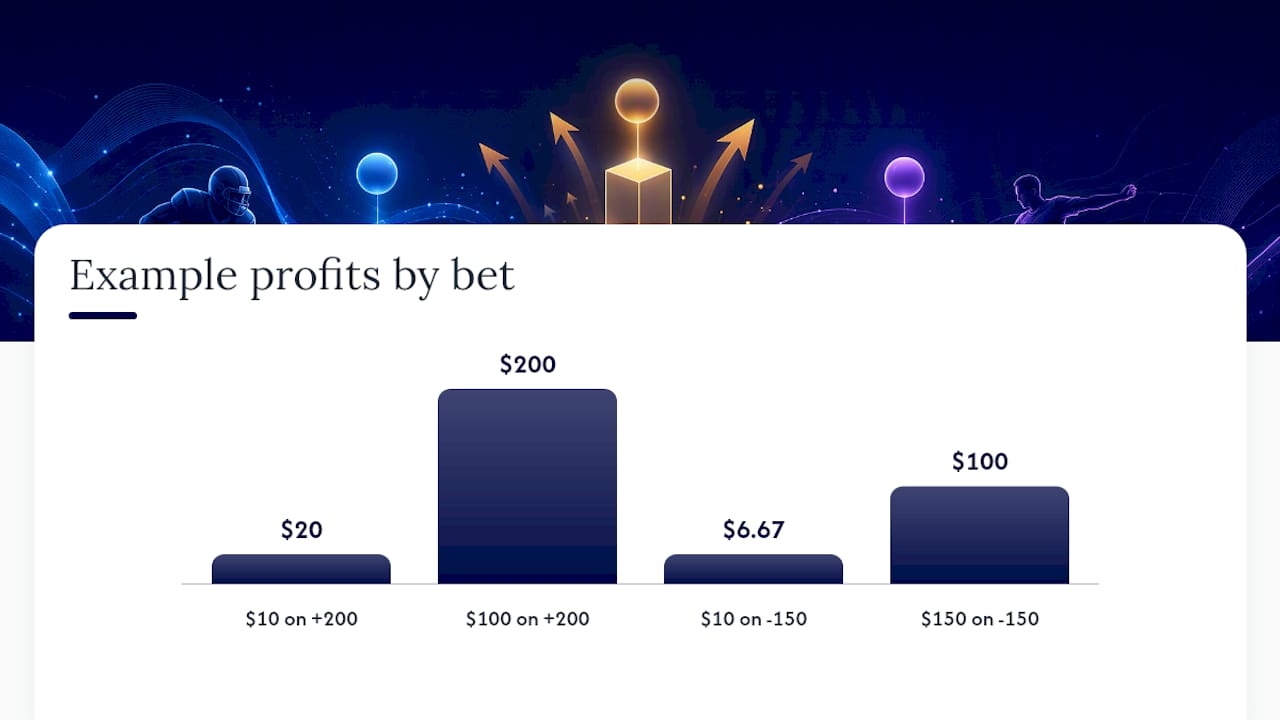
Here’s how that plays out with real stakes. A $10 bet on +200 odds returns $20 in profit ($10 × 2), for a total payout of $30. A $100 bet on the same line returns $200 profit, for $300 total. Flip it to a favorite at -150: a $10 bet returns $6.67 in profit ($10 × 100/150), for a $16.67 payout. A $150 bet on -150 wins exactly $100 profit, which is the whole point of that number, it’s calibrated to show what you’d risk to win a flat $100.
Negative American odds mark the favorite, while positive numbers mark the underdog, and once that sign convention clicks, the math is just multiplication.
How to Read Decimal Odds and Calculate Your Return
Decimal odds are the simplest format to calculate on the fly because the number represents your total return per $1 staked, not just profit. Multiply your stake by the decimal, and you get everything back, including your original bet.
The core formula: Total payout = stake × decimal odds. Subtract your stake from that number, and you have your profit.
- 1.67 odds: A $10 bet returns $16.70 total ($6.70 profit)
- 2.50 odds: A $10 bet returns $25.00 total ($15.00 profit)
- 3.20 odds: A $10 bet returns $32.00 total ($22.00 profit)
Converting decimal odds to implied probability is just as fast: divide 1 by the decimal number. At 1.67, it’s roughly 60%.
Decimal odds show the total return per $1 wagered, stake included, which is exactly why they’re popular outside the U.S. and increasingly common on American apps too. There’s no sign to interpret, no separate math for favorites versus underdogs, just one multiplication step. If you’re doing quick mental math on your phone between quarters, decimal odds are usually your fastest path from number to dollar amount.
How to Read Fractional Odds and Convert Them to Payouts
Fractional odds express profit as a ratio against your stake, written as profit divided by stake. A line of 3/2 means you win $3 in profit for every $2 you risk. Multiply that ratio by your actual stake to find your payout.
At 3/2, a $20 bet returns $30 profit (3/2 × 20), for a $50 total payout. At 1/4, a $20 bet returns just $5 profit, since 1/4 is a heavy-favorite price. At 7/1, that same $20 bet returns $140 profit, reflecting a long-shot underdog.
- 3/2 converts to 2.50 decimal and +150 American
- 1/4 converts to 1.25 decimal and -400 American
- 7/1 converts to 8.00 decimal and +700 American
Fractional odds are common in UK bookmaking and horse racing, where you’ll still see boards listing prices like 5/2 or 9/4 instead of decimals or moneylines. If you bet on the Kentucky Derby or follow European racing markets, fractional literacy matters even if you never use the format anywhere else.
Converting Between Odds Formats and Finding Implied Probability
Every odds format converts cleanly into the others, and every format converts into implied probability, the break-even win rate a bet needs to hit for you to profit long term.
- Decimal to implied probability: 1 / decimal odds. A 2.00 decimal equals 50% implied probability.
- Positive American to implied probability: 100 / (odds + 100). At +200, that’s 100/300 = 33.3%.
- Negative American to implied probability: odds / (odds + 100) as a positive number. At -150, that’s 150/250 = 60%.
- Cross-format conversion: -150 American equals 1.67 decimal equals roughly 2/3 fractional, since all three describe the same 60% implied probability.
Sportsbooks build in a margin, often called the vig, that pushes combined implied probabilities above 100%. A standard -110/-110 spread market, for instance, implies roughly 52.4% on each side, a combined 104.8%. That extra 4.8% is the house’s built-in edge, and it’s why you need to win more than half your bets against -110 pricing just to break even, not exactly half.
How Odds Show Up on Different Bet Types
Format literacy only matters once you see it applied to the bets people actually place. Moneylines apply straight win/loss odds to a game (Team A -200, Team B +170). Point spreads attach odds, usually -110 on each side, to a margin of victory (Team A -6.5 at -110). Totals work the same way, pricing over/under a projected combined score. Player props and season futures often use plus-money American odds even on favorites, since the probability of any single specific outcome is lower.
Parlays multiply the decimal odds of every leg together. A three-leg parlay with legs at 1.91, 2.10, and 1.80 pays out at 1.91 × 2.10 × 1.80 = 7.22 on the combined bet, meaning a $10 stake returns $72.20 total.
- Moneyline example: $50 on -200 returns $25 profit ($75 total)
- Spread example: $110 on -110 returns $100 profit ($210 total)
- Parlay example: $10 across three legs at combined 7.22 decimal odds returns $72.20 total
Pro Tip: *Every added parlay leg multiplies your potential payout, but it also multiplies your risk of losing the whole ticket.
Why Betting Lines Move (and What the Vig Really Costs You)
Lines rarely sit still from the moment they’re posted to kickoff. Injury news, roster changes, weather reports, and heavy betting volume on one side all push a number in real time. Odds shift because sportsbooks react to new information and to where money is flowing, adjusting prices to balance their books and limit how much they’d lose if one outcome hits.
That -110/-110 example from earlier isn’t an accident. The implied probabilities on both sides of a standard spread market add up to more than 100%, and that extra percentage is the vig.
- Injury news and lineup changes shift lines within minutes
- Heavy public money on one side pulls the number toward that side
- Weather affects totals in outdoor sports more than spreads
- Late scratches or lineup swaps can move a line sharply right before close
The practical fix is simple: compare the same bet across multiple sportsbooks before placing it. Shaving even a few cents off the vig on every bet adds up over a full season.
Quick Mental Shortcuts for Reading Odds Fast
You don’t need a calculator app open every time you glance at a board. A few rounded shortcuts get you close enough to judge a line in real time.
- +200 ≈ 33% implied probability (underdog getting decent value)
- -150 ≈ 60% implied probability (moderate favorite)
- Decimal odds minus 1 ≈ your profit multiplier (2.50 odds means 1.5x profit on your stake)
- Round conservatively when estimating in-play, since live odds shift fast
Pro Tip: Always convert a number to implied probability before deciding if it’s a good bet. A price that looks exciting in moneyline form can look far less appealing once you see the break-even percentage behind it.
Betting Smart: Bankroll Basics and Where to Get Help
Never bet money you can’t afford to lose, and treat odds literacy as a decision tool, not a guarantee.
- BeGambleAware offers free confidential support and self-assessment tools
- GambleAware provides education and treatment referrals
- Gambling Therapy runs free online support in multiple languages
- Gamblers Anonymous offers peer support meetings worldwide
- The National Council on Problem Gambling (NCPG) operates a 24/7 helpline
Understanding odds reduces confusion. It doesn’t reduce the actual risk of losing money, and no amount of math changes that.
Horse Racing Odds vs. Team Sports Odds: What Changes
Team sports odds are set against a fixed number that barely moves once you understand the format: a moneyline, a spread, a total. Horse racing works differently because the field itself is a moving target. Odds on a horse reflect its share of the total betting pool relative to every other horse in that specific race, not a fixed sportsbook price against the field.
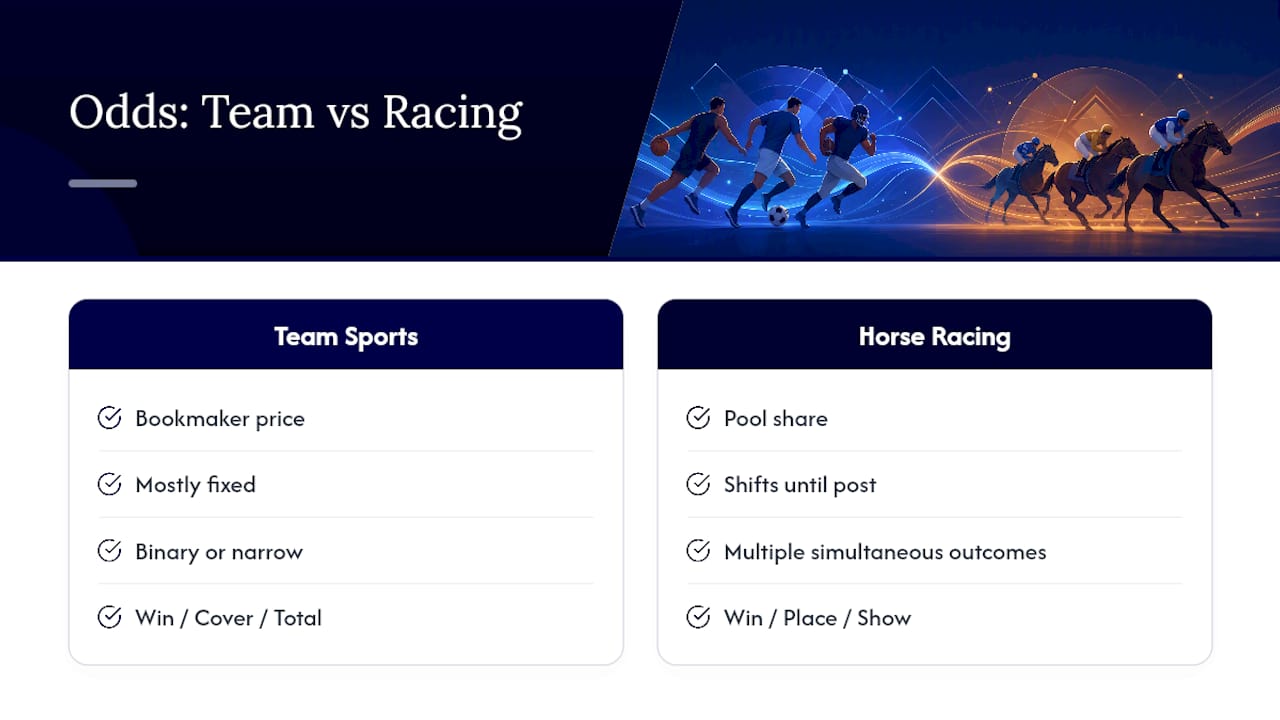
That’s why horse racing boards lean on fractional odds so heavily, particularly in the U.S. and UK. But that number can drift right up until post time as more money comes in on other horses, something that happens far less dramatically in a two-team point spread.
Team sport odds also isolate a single binary or narrow outcome, win, lose, cover, or not cover. Horse racing prices multiple finish positions simultaneously: win, place, and show, each with its own separate payout structure and its own odds. A horse can be a poor bet to win outright but a strong value bet to simply finish in the top three.
If you’re used to reading NFL or NBA lines, expect an adjustment period with racing boards. The math (converting fractional to implied probability) stays identical. What changes is the why behind the number: a fixed bookmaker price in team sports, a live, shifting pool consensus in racing.
How Odds Formats Shape the Way You Think About Risk
The format on the screen changes how your brain processes a bet, even when the underlying math is identical. American odds put a spotlight on the “how much to win $100” framing, which can make favorites feel deceptively cheap and underdogs feel deceptively lucrative, since the number itself doesn’t show probability directly.
Decimal odds strip that framing out entirely. Seeing “1.91” forces you to think in terms of total return, which tends to produce a more sober, probability-first read of the bet. That’s part of why decimal odds are often considered easier for beginners: the format doesn’t disguise the payout behind a sign convention.
Fractional odds sit somewhere in between. A “9/4” reads less intuitively at a glance than either American or decimal, but it emphasizes the profit-to-stake relationship in a way that can make risk feel more concrete, especially for bettors used to racing markets where that ratio has real meaning.
None of this changes what a bet actually pays out. But the framing does affect decision-making. Converting every line to implied probability before you bet strips out that psychological noise and forces an apples-to-apples comparison, regardless of which format the sportsbook happens to display.
How to Use Odds for Value Bets and Arbitrage
A value bet exists when your own estimate of an outcome’s probability is higher than the sportsbook’s implied probability.
Finding value starts with the conversion formulas covered earlier. Convert every line you’re considering to implied probability, then compare that number against your own research, injury reports, statistical models, situational trends, rather than against the odds themselves. The number on the board is a market price, not a prediction, and treating it as a price to evaluate rather than a fact to accept is the core skill behind value betting.
Arbitrage works differently and requires no prediction at all. This depends entirely on odds discrepancies between books, which is why comparing lines across multiple sportsbooks before placing a bet matters for arbitrage far more than for a straightforward moneyline play.
Both strategies depend on the same underlying skill: fast, accurate conversion between formats and implied probability. Consistently shopping for better lines and avoiding excessive vig compounds into a real edge over a full season, even for bettors who aren’t running formal arbitrage plays.
What I’ve Learned Teaching People to Read Odds
Most beginners don’t struggle with the math. They struggle with treating the number on the screen as a prediction instead of a price. That distinction is the whole ballgame. A -200 favorite isn’t a promise, it’s the market’s collective guess dressed up in a format that happens to look authoritative.
The single biggest mistake I see is skipping the implied probability step entirely and betting off vibes about which format “sounds like a better deal.” A +650 underdog feels thrilling.
This platform was built around that gap, the space between seeing a number and understanding what it actually means. Odds comparison across sportsbooks, a built-in parlay calculator, and shareable BetSlips exist because conversion math shouldn’t be the barrier between a beginner and a smart bet. Use the tools to practice the formulas in this guide until they’re automatic, not just theoretical.
— Fogell
Compare Lines and Build Smarter Slips With ParlayGeeks
Reading odds is step one. Acting on them across a dozen sportsbook apps, tracking which one actually has the best number, is where most bettors lose the edge they just learned to calculate. This platform addresses that specific problem: real-time odds comparison across multiple sportsbooks in one place, so you’re not manually converting formats app by app while a line moves.

Beyond comparison, a free parlay calculator does the multiplication from this guide automatically, and a BetSlip builder lets you put together a bet, share it publicly, and follow expert bettors who post their own picks and reasoning. If you want to practice implied probability conversions on live lines instead of hypothetical examples, start comparing odds on ParlayGeeks and see how the numbers actually move across books in real time.